Jacob Jenks
About Jacob
My work ethic and character were shaped early. As a Campus Security Monitor and Computer Technician I for Clark County School District, I maintain a safe, orderly environment across school grounds — patrols, policy enforcement, and incident response — while also handling elevated IT duties usually reserved for technical staff: troubleshooting hardware and software, and supporting the school's technology infrastructure.
In July 2019, I earned the rank of Eagle Scout, guided ever since by the Scout Law: trustworthy, loyal, helpful, friendly, courteous, kind, obedient, cheerful, thrifty, brave, clean, and reverent.
Today I'm studying at Utah Valley University toward a Bachelor of Science in Professional Pilot, minoring in Computer Science — working toward a career as a regional airline pilot, with the long-term goal of flying for a major carrier. In parallel, I'm building H.E.C.T.O.R., a local-first AI assistant built entirely on hardware I own — no cloud dependency, no subscription gatekeeping. I believe technology should be something you control, not something that controls you.
When I'm not working, studying, or building, I'm usually deep in research — aviation, technology, or whatever's caught my attention that week.
Outside of work and school, most of my time goes into H.E.C.T.O.R (Helpful, Engagement, Companion, Tracking, Observation, Response). — a local-first AI assistant I'm building entirely on hardware I own.
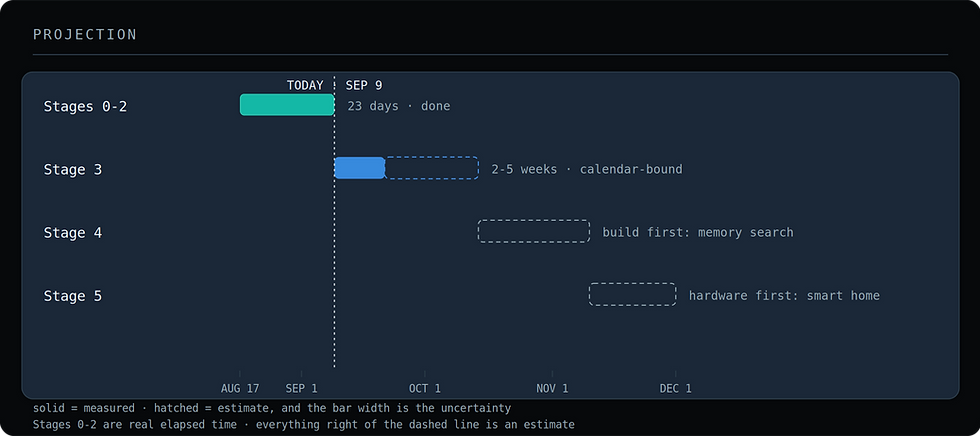
Here's progress as it stands:
My Latest Projects
01
H.E.C.T.O.R.

A local-first AI assistant, built entirely on hardware I own.
HECTOR runs on Python, Ollama, Whisper, and Piper — voice recognition, local language processing, and speech synthesis, all handled on my own PC, with zero cloud dependency. It follows the same principle as PARIS: the intelligence running your life should be something you control, not something a company can throttle or shut off.
The build follows a staged, formally tested system — Stages 0 through 2 closed after 23 real days and 1,200 automated test runs with zero hard fails. HECTOR is now in Stage 3 (Awareness), adding a wake word and camera-based vision, driven by a validated five-state visual language — Idle, Listening, Thinking, Reasoning, and Speaking — so you can tell at a glance what it's actually doing.
02
P.A.R.I.S.
H.E.C.T.O.R.'s hardware front end— MemoMind One smart glasses, chosen deliberately over nearly a dozen alternatives.
I put every serious smart glasses product on the market — Even Realities, Rokid, Vuzix, Mira, and others — against a strict list: binocular display, real battery life, sub-50g weight, and a genuine path for a developer to actually build on the hardware, not just be locked into the manufacturer's own AI. Most failed that last test outright — the ones with SDKs shipped compiled libraries with no source, or gated access behind enterprise deals I had no way into. MemoMind was the exception: a real public developer protocol, at a fraction of the price of anything comparable.
That's why P.A.R.I.S. (Personal Assistant Retinal Interface System) is a named, deliberate piece of this project rather than just "the glasses I bought." H.E.C.T.O.R.'s entire premise is owning and controlling the intelligence running your own hardware — a pair of glasses locked to someone else's cloud AI would have defeated that before I even put them on. The name is earned, not decorative.
Once paired, PARIS becomes HECTOR's eyes, ears, and display: voice in through the mic, responses out through the HUD — while all the actual thinking stays local, on hardware in my own home. No cloud round-trip, no subscription standing between me and my own assistant.

GET IN TOUCH — LET'S TALK ABOUT TECH, AVIATION, OR ANYTHING IN BETWEEN
jacobjenks1@gmail.com